
Topline
Gulf states have committed hundreds of billions of dollars to Africa over the past decade, anchored in food security, critical minerals, ports, and clean energy. The UAE alone has announced $168 billion in investments since 2017. A portion of that capital has yet to be deployed. As Gulf investors seek to rebound from the economic disruptions of the Iran war, they will prioritize investments that advance their domestic diversification agendas, strengthen their value proposition to international partners, and enhance their resilience to future conflicts. In theory, strategic investments in Africa directly support their long-term ambitions across each of these dimensions, especially in advanced technologies, global trade, diplomatic influence, and economic resilience. But converting high-level, government-to-government (G2G) frameworks into tangible investment success stories is a different challenge. It requires an expert understanding of the operating environment across African markets, insight into the factors driving policy in strategic sectors, and ongoing dialogue with key policy stakeholders to stay ahead of new developments and mitigate risk.
A clear case for GCC-Africa investment
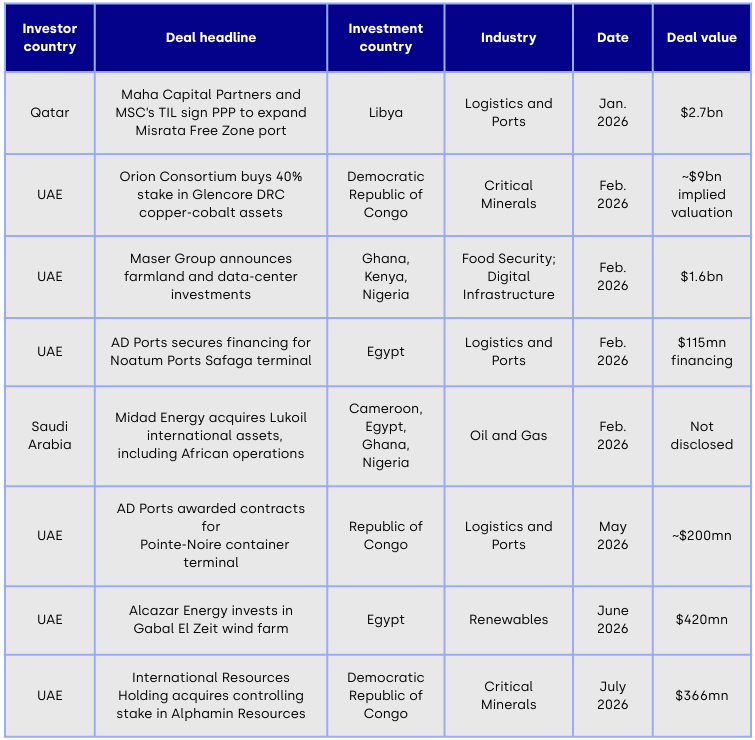
There is clear buy-in from senior leadership in Gulf governments regarding the potential for Africa investments to advance their strategic priorities. Both the UAE and Saudi Arabia, the two most active GCC investors in Africa, have anchored their national strategies around the development of advanced technology sectors; the diversification of their economies beyond hydrocarbons (including through investment in clean energy to prepare for a post-oil future); and the expansion of global soft power and diplomatic influence through investment ties and trade relationships. Even before the conflict with Iran, both countries were taking steps to bolster their resilience through trade relationships and ownership of food supply chains, learning from previous episodes such as the COVID-19 pandemic and Qatar’s success in weathering the 2017-2021 blockade imposed by Gulf neighbors and other regional states. The conviction that investments in Africa can help with each of these priorities is evident in the types of deals Gulf countries are pursuing on the continent (see Figure 1). Many of these investments also advance African governments’ own infrastructure, industrialization, energy, and development priorities, creating significant areas of strategic alignment between investor and host governments. Beyond these deal announcements, there is strong G2G momentum for an expanded GCC investment presence in Africa through initiatives like the UAE’s Comprehensive Economic Partnership Agreement (CEPA) program, which includes trade and investment deals with at least ten African countries.
Figure 1: Select Gulf State Investments in Africa in 2026
From announcement to activation: Africa requires local expertise
Behind the headlines, implementation has proven harder than announcement. GCC investors announced $60 billion across 83 projects in Africa in 2022 and more than $53 billion across 73 projects in 2023. But headline investment figures obscure substantial variation in what happens next: Some projects move rapidly from political agreement to financing and operations, while others remain in development, are restructured, or fall away altogether. The relevant execution gap is therefore not simply the difference between announced investment and annual FDI flows. It is the gap between securing political agreement and navigating the commercial, regulatory and stakeholder hurdles required to turn that agreement into an operating asset. Even with the backing provided by high-level G2G frameworks, entering these markets and securing support from local stakeholders can be highly complex for investors without deep experience on the continent. The withdrawal of a UAE-backed investor from the $34 billion Mauritania green hydrogen project after the development encountered delays is one particularly visible example.
Several factors consistently challenge deal closure:
- Commitments can struggle to outlive the governments that made them. Head-of-state backing is not a substitute for durable contractual architecture. Investors need protections calibrated to political transition and regulatory change, including change-in-law, termination, compensation, and dispute resolution provisions. Yet contracts cannot anticipate every shift in interpretation or application, making regulatory intelligence and working-level engagement essential complements.
- Regulatory risk lives in application, not statute. Formal rules provide only part of the picture. How they are interpreted, enforced, and administered can have just as much bearing on project timelines and returns. Investors therefore need to understand not only what the regulatory framework says, but how key institutions are likely to apply it in practice.
- High-level engagement does not substitute for working-level relationships. When engagement intensifies around summits but fades between them, investors can lack the institutional relationships needed to resolve implementation challenges as they arise. Sustained engagement with regulators, ministries, and other relevant stakeholders helps identify emerging obstacles early and maintain momentum between senior-level interventions.
- Public perception has become a commercial variable. In strategic sectors, particularly critical minerals, local content expectations are hardening into regulations and governments are responding to constituencies skeptical of extractive investment. Investors who build local standing early will be better positioned to resolve approvals, renewals, and disputes than those who arrive only with capital.
What makes this moment different is that the cost of the execution gap is rising for three key reasons:
- Regulatory and political changes are outpacing the agreements that govern Gulf investments. In the DRC, authorities suspended cobalt exports outright in February 2025, only to replace the ban four months later with a quota regime that caps exports at 96,600 tons annually through 2027. In Senegal, the administration elected in March 2024 has spent the subsequent two years reviewing oil, gas, and mining contracts signed under its predecessor. Both cases illustrate how rapidly regulatory shifts and political transitions can alter the commercial risk landscape for investors.
- The supply of tier-one assets is shrinking. Gulf, Chinese, Western, and, increasingly, African institutional investors are competing for the same pool of critical minerals projects and strategic logistics assets. At the same time, consolidation across the copper and cobalt sectors is accelerating, reducing the number of high-quality acquisition opportunities. As competition intensifies and available assets become scarcer, investors that move now are likely to secure more favorable terms than those that delay.
- Execution records will soon become visible and comparable. As CEPA-style agreements and bilateral investment platforms mature, governments and co-investors will increasingly distinguish between actors that have translated strategic frameworks into financed and executed transactions and those that have merely accumulated memoranda of understanding. In a crowded investment landscape, a demonstrated track record of execution is likely to carry more weight in future negotiations than the headline value of announced commitments.
Recommendations for Gulf-based Investors
The strategic rationale for investing in Africa remains compelling, and G2G momentum continues to strengthen. The challenge for Gulf investors is how to convert political commitments into operating assets in a deliberate, efficient, and risk-conscious manner. Investors should focus on several practical priorities:
- Stress-test committed deals. Review and strengthen contractual protections against political transition risk before they are tested.
- Maintain engagement at the working level. Continuously monitor regulatory developments and sustain working-level relationships in priority markets rather than relying solely on periodic high-level government engagements.
- Favor reforming markets. Track jurisdictions that are opening, where early movers can capture assets, others have written off. Nigeria’s currency reform is the clearest recent example.
- Decide deliberately. Align internal stakeholders on which commitments are strategic and which are opportunistic, so that any slowdown is a choice rather than a drift.
Executing these steps requires on-the-ground capabilities that most investment teams do not carry in-house: regulatory intelligence that reads application rather than text, repatriation navigation that anticipates where capital gets trapped and released, cross-market coherence for investors operating across several jurisdictions at once and sustained in-market and community engagement between senior touchpoints. For investors deciding where and how to deploy, the question is no longer whether Africa fits the strategy but whether the execution model fits Africa.
About DGA Group
DGA Group is a global advisory firm that helps clients protect – and grow – what they have built in today’s complex business environment. We understand the challenges and opportunities in an increasingly regulated and interconnected world. Leveraging the expertise and experience of our team at Albright Stonebridge Group, a leader in global strategy and commercial diplomacy, and a deep bench of communications, public affairs, government relations and business intelligence consultants, we help clients navigate and shape global policy, reputational and financial issues. To learn more, visit dgagroup.com.
For additional information or to arrange a follow-up, please contact Pierre.Tantchou@dgagroup.com and Ben.Gordon@dgagroup.com.